by Philip Gardiner and Gary Osborn
Over the course of many years and with more air-miles than we care to remember, we have journeyed on a quest to uncover the secrets of the ancient serpent cults that we reveal in our books. Each time we journey, we discover something new. There truly is a whole new world opening up before our eyes, and suddenly and often without warning we are faced with a re-interpretation of history that we are simply not looking for.
Now in another twist in the tale of the serpent we uncover one of the ancient truths about dragons, remembering that in myth and in ancient history, dragons and serpents are intertwined like the coils of a pit viper.
We need to begin in America of all places, for two reasons. Firstly that this is the last place we would even consider looking for dragons, and secondly because the evidence is most profound here in archaeological terms.
 The evidence of serpent worship in the Americas can largely be shown via the many serpent mounds that appear across the continent. The most famous by a long way is the Serpent Moundof Ohio, Adams County. According to some [1] this marvellous mound is related to Stonehenge and they say that it is the “Dragon Guardian” of the East to Stonehenge’s Secret of the West. Indeed it is thought that the two ancient structures actually do share the same timeline and may very well have born relationship to each other, if indeed ancient man shared the same beliefs and travelled extensively, as is the growing belief of many scholars. Of course Stonehenge is also directly north of that infamous serpent temple, Avebury.
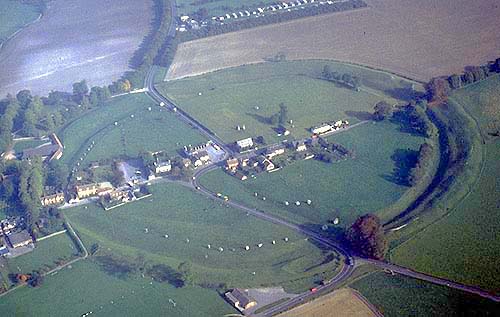 Avebury is a huge British Temple and stone monument erected around 2,000 BC in the shape of a serpent when seen from the sky. Once known as Abury which according to Deane [2] is evidently Abiri or Ab-ir (after the Abiri people or Cabiri who were serpent worshippers). Abir incidentally means the solar snake or fire snake.
Although some have argued whether Avebury should ever have been Abury or Aubury (serpent sun) the fact remains that even as far back as the 17th century there was a Mr Aubury who said himself that it should be pronounced and spelt Aubury (found in the legier-book of Malmesbury Abbey.)
Of course even as Ave Bury, the “A” reverts back to the root of”Eve” which we know means “female serpent.” The pathway of Avebury passes through a large circular Temple of the sun emerging and then winding again and ending with an oddly, not quite circular head – directly in line with “Snakes Head Hill” (Hackpen.) The central circle is symbolic of the sun, which is the male principle in the creative process and is symbolized elsewhere as a bull or lion. Once the serpent has passed through or around this sun circle it is recharged for new life.
In Egyptian hieroglyphs we can see similar imagery with the symbol of the snake going over the solar disc, emerging head erect. Overlaid onto Avebury it is the same image! Adding to this, that the snake is often depicted with the ancient Egyptian Ankh symbol dangling from its emergent neck – the Ankh being a symbol of new life – the great circle of Avebury simply has to be the “solar disk” and the pathway the snake – thus illustrating in a painfully labour-intensive way, the ritualistic path of the serpent worshipper towards new life.
The circular aspect of the Stone Circles of Europe are strangely reminiscent of the Temples of Quetzalcoatl, which were “circular, and the one dedicated to his worship in Mexico, was entered by a door like unto the mouth of a serpent.” [3] A very similar ritualistic inference to those based around Avebury and other Stone Circles.
John Bathurst Deane explains in his book on serpent worship, “A third description of temples consecrated to the service of the Ophites god remains to be considered: and these were not only the most rare, the most characteristic, and the most magnificent; but, probably, the most sacred of them all. These were erected in the form of the Ophite hierogram, the serpent passing through a circle.”
This hierogram is the symbol of the serpent, a circle with a snake passing through it, like a needle and thread. He continues, “They were composed, like the circular temples, of a number of Baitulia, or amber stones, so arranged as to describe the mystic circle, through which the still more mystic serpent trailed his majestic form.”
And this is the truth of the Stone Circles and physical hierograms: that they were re-birthing circles, a being born again through the spirit, through the circle. We can even make a remarkable deduction from the strange word “baitulia” mentioned above by Deane. These are betyl stones or serpents eggs. In Wales the serpents were said to emerge and congregate on Midsummer’s Eve to blow into the Serpent Stone-Eggs or Glain Neidr, which is reminiscent of the Roman historian Pliny’s tale of this activity amongst the Gauls. These serpent stones were said to be coloured pebbles, which gave “second sight” and healing. Midsummer’s Eve was the night when the serpents would role themselves into hissing balls and create the glain egg, also known as “snake stone” or “Druid’s egg.” In Welsh myth even Merlin himself went in search of them.
The egg, Cosmic Egg or Cosmogenic Egg is universally seen with the serpent – as in the symbol of the Orphic Egg which is shown with a snake wrapped around it. From the serpent mound of Ohio to Mithras and Cneph, the egg is associated with serpent worship. Why? According to most scholars it is the emblem of the mundane elements coming from the creating god. Therefore it is a symbol of the elements of the universe. But surely there is also another reason; a reason that would relate to early man more than such complex ideas, which are ideas sprung into the mind of modern scientists and scholars?
What is an egg? Simply an “entry portal” into this world. A device to give life. And what animal is seen in relation to this unique device and portal? . . It is the snake. Again, it is the snake – a symbol of the life force – that creates the device, which gives life.
The Egyptian creator deity, Cneph, mentioned above was represented as a serpent with an egg thrusting from his m”father god” who is the same as the Indian Brahma. These Brahma have been related by scholars to the Jewish Essene community and also to Mithra we mentioned earlier. Mithra was encircled by serpents and can be equated in many ways to Jesus, being a solar divinity and reborn on the 25th of December, like the sun. There is little wonder that a Persian god such as Mithra and a Judaic semi-deity such as Jesus be linked when one understands that the folds of the ancient serpent cult were so all-encompassing that they encircled the globe like a Leviathan. We can even see elements of this when Jesus is equated to the Brazen Serpent of Moses; when we are told to be wise as serpents and that he even shed his shroud or skin once crucified upon the cross. Incidentally, snakes are still to this day nailed to trees in certain parts of Africa as a sacrifice for our sins and for healing remedies.
And so we have circular monuments and serpent mounds associated with the egg, which from all the evidence here simply gives us the conclusion that these were places of rebirth. One would push through the symbolic circle, or out of the egg and slough off the old skin. But, there is more evidence yet to be unearthed and which reveals this sloughing of the skin linked with these ancient sites.
The classical Greeks frequently depicted a serpent squeezing between two upright stones, which they called Petrae Ambrosiae (stone or rock ambrosia); noting that Ambrosia is the nectar and Elixir of the gods. According to the 19th Century archaeologist, Bryant, Stonehenge was seen as Amber stones with nearby Amesbury – previously Ambrosbury – as proof. In this way, the healing abilities of the megalithic stones is attributed to the serpent. In fact we do still find traces of this in many stories about dragons, who protect, serve and heal those ancient people of the stones.
The antiquarian and stone circle spotter extraordinaire William Stukely also found two other “serpent temples,” one at Shap in Westmorland and the other at Classerness in the island of Lewis. In fact Stukely thought that the Greek legend of Cadmus sowing dragon’s teeth alluded to his building a serpentine temple. In fact Cadmus was turned into a serpent (or followed the serpent cult) and stone temples were erected in his and Harmonia’s honour. Pausanius helps us along and points out that “In the road between Thebes and Gilsas, you may see a place encircled by select stones, which the Thebans call The Serpent’s Head.” So, ancient tales may in fact be clues to the real identities of the serpents and dragons of fable, and these real identities may in fact be real and literal places and monuments. Places where, perhaps, snakes were held in high esteem by the ancient ophites or serpent worshippers of the world.
There are many more texts mentioning dragons and serpents, such as the one that Taxiles showed to Alexander the Great and which was sacred to Dionysus. It was said to be of enormous size, walled around and resided in a low, deep place. It is our conjecture that such places, like Stonehenge, were “portals” or “gateways” to the “land of the serpents;” places of mystery and rebirth, where offerings and sacrifices must be made to the serpent benefactor.
Indeed, there is plenty of evidence now from people such as Paul Devereux that show such places were also great resonance boosters. That is, they amplified sound in peculiar ways, thus creating the booming sound of the dragon. They even go as far as saying that the resonance creates spiral and serpent wave-like shapes from the dust and smoke, as the sound wave carries the particles along its serpentine path. The serpent could truly have been seen to rise and heard to roar.
However, most people are not aware that similar mounds and monuments also appear elsewhere and often associated with the serpent or dragon in similar ways.
In 1871 at the meeting of the British Association in Edinburgh, a certain Mr. Phene gave an account of his discovery in Argyllshire of a similar mound, “several hundred feet long, fifteen feet high and thirty feet broad.”
The tail tapered away, while a circular cairn, which he presumed to be the solar disk above the head of the “Egyptian uraeus”, surmounted the head.
Indeed this is not a “one off.” In the Zend Avesta of the Zoroastrians one of the heroes takes a rest on what he thinks is a bank – only to find out that it was a green snake!
Iphicrates related that in Mauritania “there were dragons of such extent that grass grew up on their backs.” Thus showing the highly likely chance that tales of massive dragons in far-off lands could easily be Serpent Mounds.
Other instances of Serpent Mounds however are to be found mentioned by Strabo (Lib xv. P.1022) where two dragons are said to have resided in the mountains of India, one eighty cubits long and the other one hundred and forty. Posidonius also tells of one in Syria, which was so large that horse riders on either side could not see each other. Each “scale” was as big as a shield, so that a man “might ride into his mouth.” Bryant concurs with the belief that these must be ruins of Ophite temples.
And what were these Temples used for?
In ancient Egyptian papyri and in the Mesoamerican, codex borgia there are instances or tales of the King entering the serpent and going through it in-order to be resurrected – much like those we find in the myth of Osiris.
A book said to have been written by Votan (Quetzalcoatl) in the language of the Quiches and thought to have been in the possession of Nunez de la Vega, the Bishop of Chiapas, has some revealing elements – so revealing that the Bishop tried to burn it. Votan says he left Valum Chivim [4] and came to the New World to apportion land among seven families who came with him and were said to be culebra or of serpent origin. Passing the “land of thirteen snakes” he arrived in Valum Votan, founding the city of Nachan (City of Snakes), thought to be modern day Palenque, possibly around 15 BC or even earlier. Votan is said to have made four trips to the east and even to have visited Solomon.
Interesting to Serpent Mounds however is the description of a subterranean passage, which is said to terminate at the root of “heaven.” This was called a “snake’s hole” and Votan was only allowed in because he was the son of a snake. Surely this can only mean that Votan was an initiate in the serpent cult and that there was a ritualised Serpent Mound or pyramid which led to snake heaven or Patala.
The Fenian heroes of ancient Ireland are recorded orally in song and one of them, Fionn, was their “dragon slayer.” One of the legends tells us that:
It resembles a great mound, its jaws were yawning wide;
There might lie concealed, though great its fury,
A hundred champions in its eye-pits.
Taller in height than eight men,
Was its tail, which was erect above its back;
Thicker was the most slender part of its tail,
Than the forest oak which was sunk by the flood.
Fionn asked where this great monster had come from and was told, “From Greece, to demand battle from the Fenians.” It seems that the serpent worshippers had come to Ireland, believed to be from Greece, and had fought the ancient inhabitants, leaving behind such terror of them that they became symbolized as this great “dragon mound.” Fionn, it is said, opened the side of the dragon and released the men, going on to kill it. It may be that there is a mixture of wartime fact built in with ritualistic truth in this legend. Emerging from the side of the dragon, as in other myths, gives new life. In this way, it is no different to the Celtic cauldron of rebirth – something else also linked intricately to the serpent.
Notes
1. See: http://www.greatserpentmound.org.
2. John Bathurst Dean in Worship of the Serpent Traced Throughout the World and its Traditions Referred to the Events in Paradise (1830). Deane also believed that the Kaaba or Caabir of the Muslims – which was a conical stone – resolved itself into Ca Ab Ir – the -Temple of the Serpent Sun.
3. Hargrave Jennings, Ophiolatreia
4. Chivim is a Hebrew word, meaning “sons of the female serpent” (or Eve) and may imply a greater knowledge of this journey from a Judaic perspective.
About the authors:
Philip Gardiner and Gary Osborn are the authors of the best selling The Serpent Grail, The Shining Ones and Gnosis: The Secret of Solomon’s Temple Revealed. They do talks, lectures, have their own radio show and do tours across the world via www.powerplaces.com. Philip Gardiner has a degree in marketing and 9 diplomas ranging from etymology to holistic medicine. He is hosting the Philip Gardiner’s Forbidden Knowledge Conference UK (FKCUK) in July 2006. The authors websites are www.philipgardiner.net, www.gardinerosborn.com, www.serpentgrail.com, www.theshiningones.com
Copyright 2005 by Philip Gardiner and Gary Osborn. Used with permission.
Avebury photo by Martin Gray courtesy of SacredSites.com.